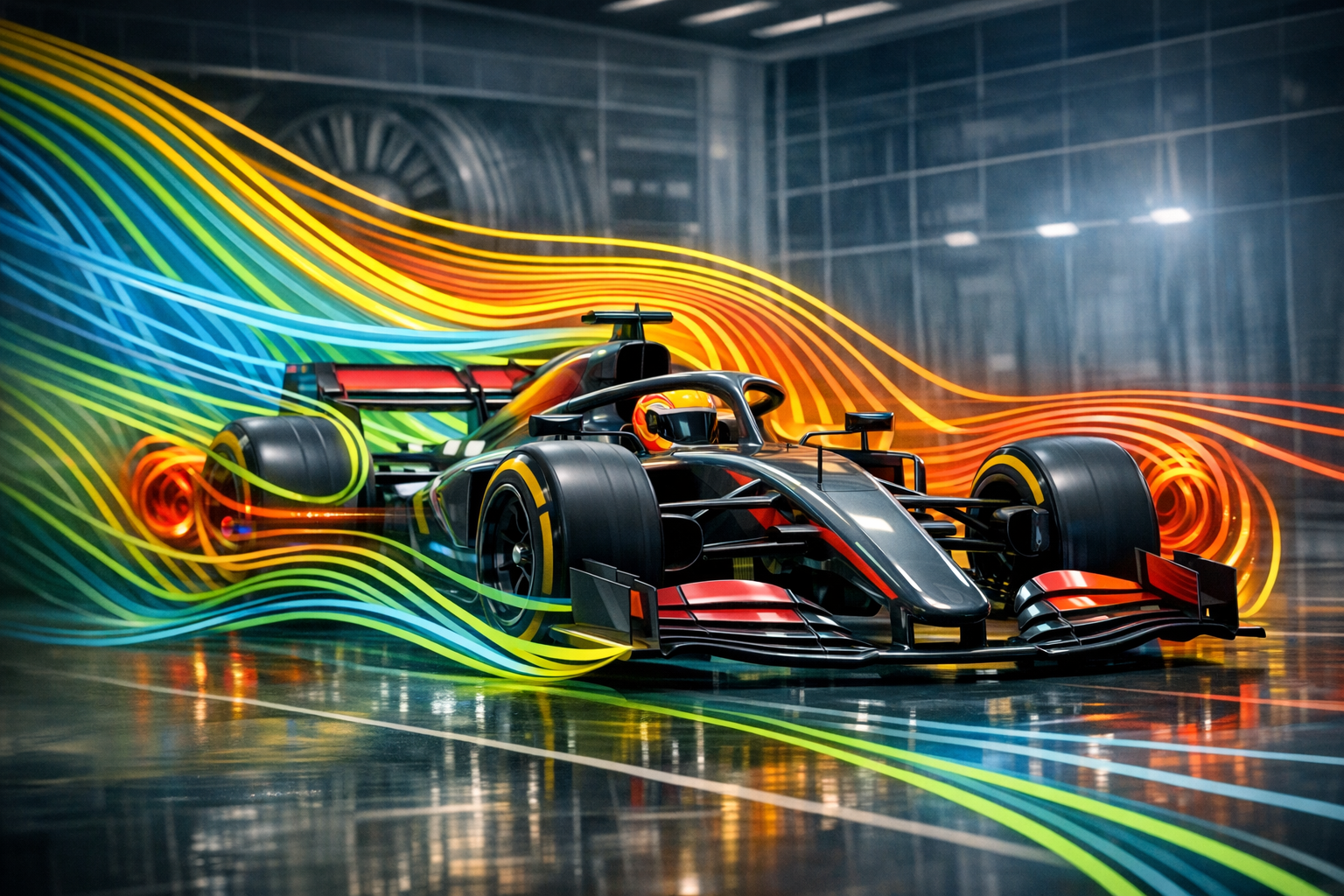
Aerodynamic evolution: F1’s ground effect era
Summary
In 2022, Formula One introduced new regulations bringing forward a new ground effect era to reduce dirty air for the car behind. This dirty air caused instability and overheating for following cars hindering their ability to overtake. The simplified rear wing design aimed to clean up the wake behind the car and minimise turbulence produced.
To test this, two rear wing models were created using SolidWorks and simulated in Starccm+: one pre-regulation (2018) and one post-regulation (2022). Simulations reveal that the 2022 rear wing design achieved all the goals it was set out to achieve, however the design sacrificed a significant amount of downforce in the process. This loss has been compensated through enhanced underfloor aerodynamics central to the ground-effect concept.
By Dean Jarrett
Introduction
Formula one racing began in 1950 and has since established itself as the world’s most prestigious motor racing competition, as well as the most popular sporting series.[1] In 2021, the sport attracted an average of 70.3 million TV viewers per Grand Prix, marking a 13% increase year-over-year and representing the highest viewership since 2013.[2] In response to this climb in audience engagement, the FIA (Governing body for Formula one) opted to implement regulatory changes in 2022. These modifications considered both driver and spectator concerns regarding the overtaking issue. F1 cars would lose considerable downforce while following a leading car, making it extremely difficult to overtake.[3]
These changes were made with careful consideration to their goal for net-zero carbon emissions by 2030.[1] To address these challenges, Formula 1 transitioned into a ground effect era for the 2022 season where the focus point is creating low pressure under the car. This created a suction effect and consequently pulled the car down on the track, improving grip.[4] This regulation shift involved numerous alterations to the car’s design including, and focused on in this project, the rear wing. The change looked to eliminate leakages caused by the wing, thereby facilitating cleaner airflow from the rear of the car and consequently promoting closer racing.
Downforce
Downforce represents the vertical component of the aerodynamic forces acting on the car. The amount of downforce generated directly influences the car’s ability to handle corners at high speeds and improve its overall handling characteristics. As the car travels through the air, the downforce effectively presses the car downwards onto the track. However, it is important to note that increased downforce results in increased drag, which will impede straight-line speed due to the increased contact friction.[5]
Downforce plays a crucial role in formula 1, as it enhances grip on the track and provides the driver with greater control during high-speed manoeuvres. Augmenting aerodynamic grip consequently increases mechanical grip generated by the car’s tires, suspension and overall weight. Modern Formula 1 cars are capable of producing approximately 750kg (1653 pounds) of downforce when travelling at a velocity of 100mph (44.7ms-1). Given that downforce significantly affects traction, in theory an F1 car, weighing less than the downforce it generates, could drive upside-down on a ceiling. [6]
Dirty Air and Leakages
Dirty air refers to the phenomenon that occurs when a car is following another around corners and are therefore already in a limited grip condition. The leading car generates downforce by utilising the energy from the oncoming flow, which in return creates a region of slow-moving air and low pressure called dirty air. This disruption in the airflow adversely affects the aerodynamic performance of the following car.
The challenges of overtaking in such conditions extend beyond just the reduction in downforce as the driver’s perception of the car’s handling changes. Drivers typically set up the aero balance to accommodate their driving style, track conditions and track layout. However, when the front wing encounters this low energy airflow, the car starts to lose its aero balance and consequently compels the driver to ease off. The driver then starts to back out of corners due to lack of grip which results in the decline in performance. This makes overtaking extremely difficult. [7]
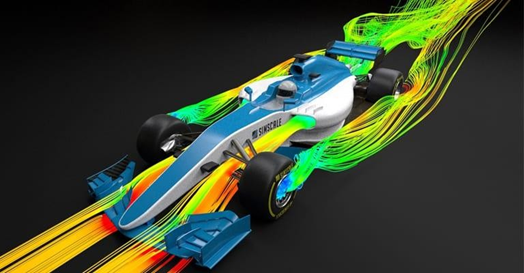
Figure 1 – Airflow coming of an F1 car. [8]
As illustrated in Figure 1, the car in front generates a churning and turbulent wake, a less-than optimal airflow condition in order to extract the prodigious amounts of downforce that allow the cars to perform so highly. Engineers have designed their cars to optimise performance by directing the wake produced by the front wheel’s outwards, preventing it from interfering with other aerodynamic elements. This outwash strategy inadvertently allows this volatile airflow to combine at the rear of the car, affecting any cars following close enough behind. [9]
The issue of overtaking in Formula 1 is very importance as prior to the regulation change in 2022, cars would experience a reduction in downforce of 35% when 20-meters behind, and a staggering 46% when 10-meters behind.[10] This is particularly critical given the highly refined and sensitive nature of formula 1 cars.
Rear Wing
Formula 1 rear wings are an essential aerodynamic component that generate downforce and thereby improve traction and cornering performance. These wings can be found mounted on the rear of the car. Notably, the rear wing is one of the few elements of a F1 car that is heavily customisable, with its design, angle, and position being adjustable to optimise downforce levels according to specific track conditions and driver preferences.[11]
Downforce Generation
A primary function of the rear wing is to generate downforce. Acting as an inverted aerofoil, the rear wings curved shape redirects airflow upwards over the wing. Understanding Newtons third law, the airflow creates an equal and opposite reaction force directed downwards, downforce.[12]
Figure 2 demonstrates the reverse of this, generating lift instead of downforce, but operates under the same fundamental physics. The design of the inclined mainplane facilitates the airflow and angled flaps further enhance the downwards momentum compared to a single-element wing.
Additionally, the rear wing operates in accordance with Bernoulli’s principle; as the air accelerates bellow the wing, pressure decreases, creating a pressure difference between the upper and lower surfaces of the wing. This differential exerts a downwards force on the car.[13] A Formula 1 rear wing can generate up to 500kg of downforce therefore enabling the cars to corner at forces exceeding 5g, all attributing to the optimisation of these aerodynamic principles.[14] All this can be seen in Figure 3, demonstrating Newtons third law, and figure 3, demonstrating Bernoulli’s principle.


Rear Wing Tuning
Teams aim to achieve an equilibrium between drag and lift, as enhancing downforce improves cornering grip, drag hampers top-end speed. The optimal rear wing design generates maximum downforce whilst minimising drag; to achieve this, aerodynamicists use complex shapes and advanced materials to reshape and accelerate airflow smoothly.[12] This delays the onset of turbulence-induced separation, a phenomenon that occurs when turbulence causes flow to detach from the surface and causes a wake to form.[17] The angle of attack is crucial in finding the optimal middle ground between lift and drag. More extreme angles increase downforce but also introduce energy-sapping turbulence behind the wing.[12]
As one of the few unrestricted aerodynamic components, the rear wing provides teams with considerable flexibility for tuning. Drivers depend on these adjustments to push qualifying laps and manage tire degradation throughout races. Teams tailor rear wing configurations to suit the specific characteristics of each circuit. Higher downforce aero setups allow for faster cornering at circuits like Monaco, while lower drag setups aim to better straight-line performance at power-centric tracks like Monza. Additionally, the rear wing is equipped with DRS (drag reduction system), a driver operated system that minimises aerodynamic drag, thereby boosting the car’s top end speed and facilitating overtaking on long straights. [12]
The rear wing is designed to interact with other aerodynamic components, as its effectiveness in generating downforce is significantly diminished when functioning in isolation. The design of the car’s rear body is optimised to ensure that a maximum airflow volume reaches the rear wing; for instance, the expansive underbody accelerates air upwards into the wing’s path.[12]
Create Your Own Website With Webador